
Return to 2nd Quarter 2026 articles.
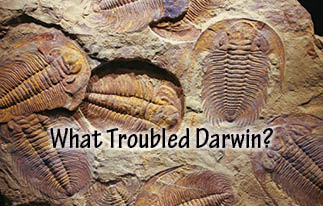
In 1831, Charles Darwin, a recent Cambridge University graduate, helped experienced geologist Adam Sedgwick excavate rock layers in northern Wales. They discovered fossils in shale dating to the Cambrian period of Earth's history. At age 22, Darwin did not realize how significant their findings were. It was not until many years later, when he published his book On the Origin of Species, that he was troubled by the “explosion” of Cambrian fossils. What exactly troubled Darwin about these fossils?
Scientists call the sudden appearance of Cambrian fossils the “Cambrian explosion.” These fossils come from a time when Earth's first major animal groups appeared abruptly, with no clear predecessors. This challenges the idea of gradual evolution. That is what troubled Darwin. The Cambrian explosion was the rapid appearance of most of the major animal groups that ever lived on Earth.

Darwin published his famous book On the Origin of Species in 1859, twenty-eight years after helping find the first Cambrian fossils. He believed life's history would look like a branching tree, starting with single-celled organisms and each branch gradually becoming more complex. He thought that life evolved in small steps over long periods through natural selection. What troubled Darwin was the sudden appearance of Cambrian fossils without ancestors, but he expected future fossil discoveries to show gradual evolutionary changes.
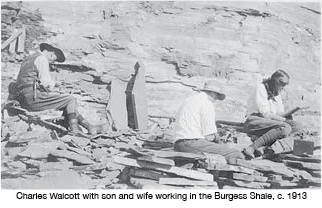
However, things did not go as Darwin expected. In 1886, during the construction of the Canadian Pacific railroad across Canada, new Cambrian fossils were found in the Rocky Mountains. In 1909, Charles Walcott discovered fossils of soft-bodied Cambrian animals without predecessors in the Burgess Shale of British Columbia. These new animal forms were more complex than the ones Darwin knew, yet they still appeared suddenly without showing gradual evolution.
In 2014, another site in British Columbia, called Marble Canyon, revealed more troublesome fossils. In 1988, paleontologists uncovered exceptionally well-preserved specimens in Chengjiang, China. Now, another site in Huayuan, China, has revealed even more soft-bodied fossils with remarkable soft tissue preservation. Researchers have collected over 50,000 fossils and identified 153 animal species, 59% of which were previously unknown. These fossils span 16 animal phyla.
Some evolutionists suggest that missing links are hard to find because soft animal tissues do not fossilize well. But this new discovery at Huayuan preserved delicate soft tissues in detail, from worms to jellyfish, showing gills, guts, and even nerves. They were preserved because they were buried quickly in a muddy slurry that turned into shale.
The key point is that many animals from the Cambrian period appear suddenly on opposite sides of the planet, with no signs of gradual change. They show no clear evolution over time. Darwinism cannot fully explain this puzzle, but those who believe in an intelligent divine Creator see these discoveries as making perfect sense. What troubled Darwin in 1859 would trouble him even more today.
— Roland Earnst
Picture credits:
© Merlinus74/Bigstock.com
https://commons.wikimedia.org/wiki/File:Charles_Darwin_by_Maull_and_Polyblank,_1855-crop.png
https://commons.wikimedia.org/wiki/File:Charles_Doolittle_Walcott_(1850-1927),_Sidney_Stevens_Walcott_(1892-1977),_and_Helen_Breese_Walcott_(1894-1965).jpg
Scripture links/references are from BibleGateway.com. Unhighlighted scriptures can be looked up at their website.