
Return to 2nd Quarter 2026 articles.

Return of the God Hypothesis
by Stephen C. Meyer
HarperOne Publishers, © 2021
$24.99 (paperback), 576 pages, ISBN-13: 978-0062071514
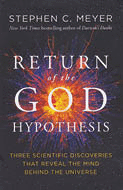
An often-repeated story has it that in 1802, French physicist Pierre Laplace gave the new emperor, Napoleon Bonaparte, a copy of his treatise on the workings of the solar system. When Napoleon asked the scientist why, in his large book on the universe, he never mentioned the Creator, Laplace replied, “I have no need of that hypothesis.” The God hypothesis has largely been ignored in modern science, but historian and philosopher of science Stephen C. Meyer has written an excellent book Return of the God Hypothesis.
Meyer looks back at the origins of modern science, showing how it began with men who believed in God and viewed science as a way to learn about God's methods. He examines the evidence for a Creator. The evidence for design in the fine-tuning of the universe strongly supports the idea that it did not happen by chance. Meyer does not use a “god-of-the-gaps” approach. Instead, he examines the inference to the best explanation for the apparent design.
Meyer examines “The God Hypothesis and the Beginning of the Universe.” Then he addresses “The God Hypothesis and the Design of the Universe.” Thirdly, he covers “The God Hypothesis and the Design of Life.” In the section on “Conjectures and Refutations,” Meyer examines the information problem in DNA and the attempts to render God unnecessary by positing multiple universes or by quantum cosmology. What I enjoyed most in the book was the last section, in which Meyer considers why the God hypothesis is so important for science and society.
This 568-page book is challenging to read but well worth it. The last 118 pages are notes, a bibliography, and an index. Even if you cannot fully digest all of the information contained here, the book is a great reference source for questions about God and science.
— Reviewed by Roland Earnst