
Return to 2nd Quarter 2026 articles.

from Does God Exist? 2nd Quarter 2026
STAY UP-TO-DATE ON NEWS AND NOTES. The stories in News and Notes are condensed from articles previously published on our website DOES GOD EXIST? TODAY. You can use the links within each of these articles to see the original posts (on the Does God Exist? Today website) for more details. (Some of the articles below have links to outside sources, which may not be available after we have published this page.) There are also many other interesting and informative articles on the Does God Exist? Today website each day. We encourage you to follow us daily on “Does God Exist? Today.” On that website you can also subscribe to our free weekly e-mail update. We call it “The Best of the Week from DOES GOD EXIST?” It contains links to the most popular of our posts on DOES GOD EXIST? TODAY and our facebook page (Facebook.com/evidence4god).
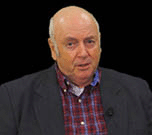
OPPORTUNITY TO STUDY WITH JOHN CLAYTON: Because of the COVID pandemic and age, we have suspended our lectureship schedule. In place of that, we are providing an opportunity for congregations to have a lectureship electronically. We want to give the readers of this publication the same opportunity to study with John Clayton.
We will mail you a DVD of the first four lectures in our video series. You or your group can watch the four programs writing down questions and challenges to the material. Please send us your questions via e-mail or postal mail, and John Clayton will respond to them. If you are satisfied with that material, return the DVD, and we mail you the next one. Your only cost is the return postage for the DVD.
If you are interested in this opportunity, please send us your name and address, and we will send you the first DVD. Watching the Does God Exist? presentations in the comfort of your home is an excellent way to receive the information from the Does God Exist? program. E-mail your request to John Clayton at jncdge@aol.com or mail your request to Does God Exist?; PO Box 2704; South Bend, IN 46680.
REFERENCES can be seen when one looks at the links within the articles below. The Internet being in a constant change, some references may be obsolete when you are reading these articles.

SPACE TRAVEL BRAIN SHIFTING: New research indicates that space travel and weightlessness can also affect your physical brain. You could call it space travel brain shifting.
Brain MRI scans of 26 astronauts and 24 non-astronauts, conducted by Rachel Seidler and others at the Massachusetts Institute of Technology (MIT), revealed how microgravity affects human brain anatomy. Their research showed that the astronauts' brains shifted backward and upward while also rotating upward. The effects could still be detected months after returning to Earth. They analyzed MRIs from 15 astronauts before and after spaceflight, and from 11 others after returning. Twenty-four other volunteers participated in a long-duration head-down tilt bed experiment.
There was a measurable change in how the astronauts' brains fit inside their skulls depending on how long they spent in space. The maximum displacement was 2.52 millimeters. The bed rest control group did not show marked changes. The question is how space travel brain shifting affects performance after returning to Earth. The astronauts did experience balance issues, apparently due to effects on the inner ear and sensory regions of the brain.
The bottom line is that the study showed that physical shifts in the astronauts' brains lasted up to six months. Again, we are reminded of how much we depend for survival on the components that God has provided on this planet.
NEW PLANT COMMUNICATION METHOD: This is not a new method plants use to communicate with each other, because they have been using it for who knows how long, but for scientists, it is a newly discovered plant communication method. The natural world is filled with astonishing forms of communication, and plants are no exception. Plant communication does not involve images, spoken words, or written texts, but can still be considered communication.
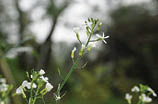
The newly discovered plant communication method involves electrical signals passing from plant to plant when leaves touch. Ron Mittler and colleagues at the University of Missouri in Columbia experimented by growing thale cress (Arabidopsis thaliana). They grew some plants in isolation and some in dense patches where the leaves touched. Then they stressed the plants by exposing them to excess light. The plants grouped together showed less stress damage than those in isolation. The researchers analyzed gene expression in isolated plants and in those that were touching. They also monitored signals passed between the grouped pants.
According to the report, the plants with leaves touching activated over 2,000 stress-response genes that could help to protect them from excess light, cold, salinity, and wounding. The isolated plants showed greater cell damage under stressful conditions.
Understanding plant communication opens new doors for agriculture, conservation, and our appreciation of design in the natural world. Mittler hopes his research may be used to design mixed plant communities that are more resilient, perhaps reducing the need for chemical pesticides or fertilizers. We believe that God has given us the tools and the talent to reveal new strategies for ecosystem management and food production.
WHAT MODERN CHURCHGOERS BELIEVE: Postmodern America is searching for answers in all the wrong places, and this is evident both in churches and in the secular world. The Family Research Council (FRC) and the Cultural Research Center (CRC) surveyed 1,000 churchgoers, adults who attend Christian church services at least once a month. The survey found that modern churchgoers' ignorance is significant.
Only 54% of churchgoers said they believe that the Bible is the true, inspired, and error-free Word of God. Only 61% can say that they believe in the God described in the Bible. Only 51% said the Bible speaks clearly on abortion, and only 47% said it is clear on homosexuality. When asked whether they prefer capitalism or socialism, 32% of churchgoers favored socialism.
Although 30% of those surveyed claimed to have a biblical worldview, the survey shows that only 11% actually do. CRC research director George Barna remarked, “This generation of churchgoers is increasingly unsure of what they believe — or why.” The challenge for church leaders is how to modify their education programs to confront this ignorance. Currently, the tendency is either to deny the problem or to offer a simplified, outdated explanation that does not meet the needs of today's young people.
GAMBLING ADDICTION IS INCREASING: Eighty million adults worldwide have a gambling disorder, and online gamblers are estimated to lose $205 billion by 2030. A large percentage of adults with gambling problems had difficult childhoods and started gambling as teenagers. Also, 17.9% of adolescents engage in some form of gambling each year.
Robert Custer was a psychiatrist who, in the 1970s and 1980s, advocated treating gambling disorder as an addiction. He started the first inpatient treatment program in 1972 and worked with thousands of people facing gambling issues. In 1985, he coauthored a book with Harry Milt titled When Luck Runs Out. He found that few people with gambling problems sought help until they experienced depression and suicidal thoughts. Custer died at age 63, but his efforts helped recognize gambling as an addiction.
During Custer's era, gambling casinos were mainly limited to Las Vegas and Atlantic City. Now, there are physical casinos across the country and casino apps on phones. Sports betting has been legalized in many states. Video slot machines and mobile gambling options enable people to lose money anytime, anywhere. Gambling addiction is increasing, and it will likely worsen until people understand that, like alcohol and drugs, gambling is dangerous and destructive to families, as well as to physical and mental health. As with alcohol and drug addictions, the key is to avoid it altogether.
BIRDS' EYE DESIGN: A group of biologists has finally solved one of the great mysteries of biology. For decades, scientists have wondered how birds can have keen eyesight without blood vessels to supply oxygen to the retina. Blood vessels provide vital oxygen to the retinas of other animals, but birds' eyes have a different design.
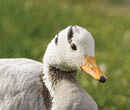
Without blood vessels that scatter the light reaching the retina, the birds' eye design enables sharper vision. How can the retinal cells function without dying from lack of oxygen? A comb-like network of blood vessels called the pecten oculi protrudes from where the optic nerve enters the eye and moves freely within the vitreous humor, the fluid filling the eyeball. It transports glucose into the vitreous humor while removing carbon dioxide and lactic acid that could harm the retina.
This discovery explains how birds like bar-headed geese can fly at elevations over 6000 meters, where oxygen is scarce. The DNA of these birds is coded to overcome specific environmental challenges while maintaining sharp vision. Encoding requires an intelligent programmer who understands what birds need to survive.
ASSISTED SUICIDED ORGAN HARVESTING: Today, in the Netherlands and Belgium, medically assisted euthanasia is legal, and anyone opting for assisted suicide may be contacted by an organ procurement organization. The same is happening in Canada, and some groups want to bring it to the United States. When medically assisted suicide becomes legal, it seems inevitable that it will lead to organ harvesting of assisted suicide victims.
Assisted suicide advocates suggest that if someone wants to die, their organs could be used to help others. Since they are going to die anyway, why not use their parts? What will stop someone from exploiting the mentally ill or disturbed, especially if there are benefits involved? What prevents abuse of the poor or vulnerable? “We will pay for medical technicians to end your life if you agree to sign your organs over to us. You won't need them, and you won't have any final expenses.”
So far, the trend of linking assisted suicide to organ harvesting has not gained wide acceptance in the United States, but it is not certain that it will not. The thought is that people who are seeking medical assistance in dying and are not terminally ill might have better organs. Instead of letting people commit suicide on their own, do it in a hospital where the organs could be harvested immediately.
Christians believe that every life is sacred, and we do everything possible to save lives. When society begins to treat some human lives as worthless and human bodies as commodities to be traded, where does it end?
USING MOSQUITOES FOR 3D PRINTING: 3D printing has become an invaluable tool in many fields, including industrial manufacturing, medical device development, and even hobbyist projects. These applications often demand nanometer-scale precision, which requires very small nozzles. Printing nozzles can be made from metal, plastic, glass, or even mosquito proboscises. Wait a moment! Did I read that correctly? Can a 3D printing nozzle actually be made from the tube a mosquito uses to pierce your skin and suck your blood? Yes, there is a way of using mosquitoes for 3D printing.
Scientists are experimenting with using a female mosquito's proboscis as a 3D printing nozzle. As you may know, female mosquitoes are the ones that feed on blood, and this approach offers a more useful way to utilize their blood-sucking appendage. It could be highly useful in advanced manufacturing, micro-engineering, and medical applications.
Many times, people have discovered more efficient processes or created new products from observing plants or animals. We call it biomimicry. We also use natural materials from plants and animals, such as skin to make leather or wood for building homes. So, why not try using mosquitoes for 3D printing?
Traditional bioprinting tips are made of non-biodegradable materials and can cost over $80 each. Lab-raised, infection-free mosquitoes cost around 2 cents each, and their proboscises are biodegradable after use. The precision tip of a mosquito proboscis can enable high-resolution drug delivery at a significantly lower cost than other options.
God has blessed us with abundant resources to advance manufacturing and medicine while safeguarding the environment. He also gave us curiosity — the drive to explore and learn new things, like using mosquitoes for 3D printing.
MARRIAGE AND CONTENTMENT: The biblical institution of marriage dates back to God's statement in Genesis 2:18: “It is not good for the man to be alone.” A study conducted by Dr. Brad Wilcox, professor of sociology and director of the National Marriage Project at the University of Virginia, has confirmed that statement. There is a strong link between marriage and contentment.

The number of people living alone is increasing quickly, and the study finds that this is a major reason for the decline in national happiness. One possible cause for this trend is that some people see marriage as linked to religious belief, yet over 40% of Americans claim no religious affiliation. Additionally, there has been a rise in the number of divorced individuals.
The survey indicates that happiness is closely tied to marriage and family. Married men between 18 and 55 report being about twice as happy as their unmarried counterparts, whereas unmarried fathers are the least happy. Married women with children report the highest levels of happiness, while single mothers are the least happy. The research shows a 30-percentage-point gap in happiness levels between married and unmarried Americans. According to the study, marital status has a greater impact on happiness than income, education, race, or location. Marriage was defined as a legal contract between a man and a woman, and the study noted that those who cohabited before marriage have a significantly higher divorce rate.
In Matthew 19:4–6, Jesus said that God created humans male and female and that marriage involves the two becoming one flesh. Studies by Wilcox and others have confirmed the validity of God's plan and demonstrate the connection between marriage and contentment.
Answers to the 2nd Quarter 2026 CROSSWORD puzzle: ACROSS: 5-Cambrian; 7-macroevolution; 9-dark; 10-weird: DOWN: 1-turning; 2-chins; 3-information; 4-patterns; 6-people; 8-image
Picture credit:
© Nerthuz/Bigstock.com
© Md Anik/Bigstock.com
© Allexxandar/Bigstock.com
© monkeybusinessimages/Bigstock.com
Scripture links/references are from BibleGateway.com. Unhighlighted scriptures can be looked up at their website.