
Return to 1st Quarter 2026 articles.
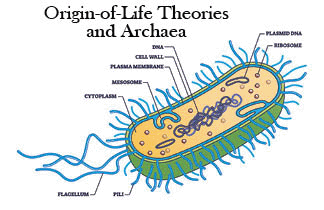
Scientists aim to answer several very difficult questions about origins. Two of these questions relate to the origin of life and the origin of complex life. Some scientists believe they are getting closer to discovering how complex life developed from simple life, and the media often sensationalizes any origin-of-life theories.
Living things are classified into three domains. We are very familiar with multicellular life, which includes plants, animals, and humans. That is the domain of eukarya, or complex life. There are two domains of single-celled life — bacteria and archaea. Most people are more familiar with bacteria than archaea. Scientists did not recognize how distinct archaea are from bacteria until the 1970s, when DNA analysis began.
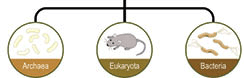
The cells of bacteria and archaea are relatively simple and small compared to eukaryotic cells, which have a membrane-bound nucleus and other internal structures, including mitochondria that supply energy. In the 1960s, one group of microbiologists described the gap between eukaryotes and the single-celled bacteria and archaea as “the greatest single evolutionary discontinuity to be found in the present-day world.” Evolutionary scientists working on origin-of-life theories needed to find a way to bridge this very wide gap.
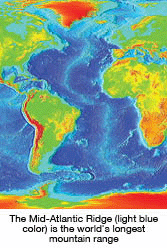
In 2008, researchers discovered a new type of archaea living in hydrothermal vents on the Arctic Mid-Ocean Ridge. They said these archaea “seemed to be somehow closer to eukaryotes than what we knew before.” In 2015, a paper published in the journal Nature described them as “the closest known living relatives of eukaryotes,” creating a scientific sensation. Their genomes were said to contain genes that are “hallmarks of eukaryotes.” Asgard archaea, as they came to be called, have since been found in other locations around the world. Scientists have theorized that they absorbed bacteria that would later become mitochondria, but there is still no evidence of a nucleus.
Research and debate on this topic are expected to continue for years, but it has sparked new speculation about extraterrestrial life. Some have suggested that unicellular life on other planets could evolve into eukaryotic, advanced life. But that assumes there is unicellular life on other planets, and that is pure speculation with no evidence.
The bottom line is that scientists cannot explain how bacteria or archaea could evolve into eukaryotic life. Even more fundamentally, scientists proposing origin-of-life theories still have no idea how non-living matter could give rise to living, reproducing cells. Be cautious when you see media stories claiming that science is close to discovering the origin of life or the origin of complex life. For decades, media reports have suggested that scientists are close to producing living cells in the laboratory. If they ever succeed in that quest, it will only demonstrate that a being with high intelligence and the proper resources can create life. That is what the Bible already tells us. Even simple cells are far too complex to have arisen by chance without a Designer.
— Roland Earnst
Picture credits:
© 441772535/Bigstock.com
© designua/Bigstock.com;
https://en.wikipedia.org/wiki/Mid-Atlantic_Ridge#/media/File:Atlantic_bathymetry.jpg
Scripture links/references are from BibleGateway.com. Unhighlighted scriptures can be looked up at their website.