
Return to 1st Quarter 2026 articles.

from Does God Exist? 1st Quarter 2026
STAY UP-TO-DATE ON NEWS AND NOTES. The stories in News and Notes are condensed from articles previously published on our website DOES GOD EXIST? TODAY. You can use the links within each of these articles to see the original posts (on the Does God Exist? Today website) for more details. (Some of the articles below have links to outside sources, which may not be available after we have published this page.) There are also many other interesting and informative articles on the Does God Exist? Today website each day. We encourage you to follow us daily on “Does God Exist? Today.” On that website you can also subscribe to our free weekly e-mail update. We call it “The Best of the Week from DOES GOD EXIST?” It contains links to the most popular of our posts on DOES GOD EXIST? TODAY and our facebook page (Facebook.com/evidence4god).
OPPORTUNITY TO STUDY WITH JOHN CLAYTON: Because of the COVID pandemic and age, we have suspended our lectureship schedule. In place of that, we are providing an opportunity for congregations to have a lectureship electronically. We want to give the readers of this publication the same opportunity to study with John Clayton.
We will mail you a DVD of the first four lectures in our video series. You or your group can watch the four programs writing down questions and challenges to the material. Please send us your questions via e-mail or postal mail, and John Clayton will respond to them. If you are satisfied with that material, return the DVD, and we mail you the next one. Your only cost is the return postage for the DVD.
If you are interested in this opportunity, please send us your name and address, and we will send you the first DVD. Watching the Does God Exist? presentations in the comfort of your home is an excellent way to receive the information without risk from COVID or the inconvenience of driving to a lectureship site. E-mail your request to John Clayton at jncdge@aol.com.
REFERENCES can be seen when one looks at the links within the articles below, references are at the bottom of those articles.

SOLAR REFLECTORS IN SPACE: Joshua chapter 10 describes an event where the Sun stood still to provide light for “about a full day,” allowing Joshua to lead the Israelites in defeating the Amorites. I do not pretend to know exactly how that happened, but I have heard a suggestion that God provided a miraculous way to reflect the Sun's light into the Valley of Aijalon until the victory was complete. From the perspective of someone in that location, it would look like the Sun stood still. Now, a California-based company called Reflect Orbital wants to do something similar with a constellation of solar reflectors in space.
Reflect Orbital hopes to launch an 18-by-18-meter (60-by-60-foot) mirror into orbit in April 2026 to test the concept. If successful, they aim to place 4,000 solar reflectors in a sun-synchronous orbit between the poles. These would follow the boundary between day and night, providing reflected light to areas in the twilight zone. Reflect Orbital claims it could enable solar power generation during peak morning and evening hours, improve crop growth, allow people to work into the night, and provide emergency lighting for disaster zones.
Astronomers and wildlife enthusiasts are very concerned. Light pollution is already a problem, increasing by 10 percent annually since the introduction of LED lights, resulting in fewer visible stars in the night sky. It is also linked to declines in beneficial insect populations, as well as increased sleep disorders and depression in humans.
Aside from affecting astronomical observations, the solar reflectors in space could disrupt migratory birds that depend on stars for guidance. Instead of merely dreaming about human potential, perhaps we should carefully consider what we should or should not do.
Reference: space.com
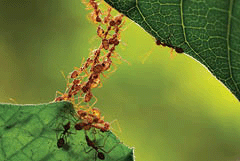
WEAVER ANT TEAMWORK: One of the most remarkable creatures in the biological world is the weaver ant. With their sticky feet and strength, weaver ants working together can suspend objects much heavier than themselves. Researchers found that an individual weaver ant could pull 59 times its own body weight, but when ants work in a group of 15, each can pull 103 times its own weight. When humans form a physical team, such as in a tug-of-war, each individual exerts less energy. In contrast, when weaver ants work as a team, each ant exerts more energy.
To complete their work, weaver ants form chains of two to four, with one behind the other. When working on a leaf, the front ants bend their legs to pull the leaf tip with their mandibles, while the rear ants hold the leaf to prevent it from flipping back.
For weaver ants to do their work, their feet must have enough stickiness to withstand the forces involved. Their legs need to be strong and rigid enough to twist a stiff leaf. The way weaver ants work as a team is just one example of the wisdom and design built into creation that allows life to thrive on our planet.
Reference: Scientific American, November 2025, page 15
SHARK SKIN BIOMIMICRY: Humans often draw inspiration from the natural world. When they adapt these designs for human use, it is called biomimicry. Shark-skin biomimicry uses design principles that allow sharks to move smoothly and quickly through water, applying them for industrial and practical purposes.
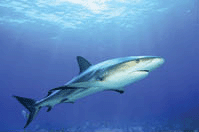
In addition to its body shape, a shark's ability to swim swiftly and quietly is largely due to the design of their skin. Shark skin has a textured pattern, known as riblets, that helps reduce water drag. Researchers at U.C. Berkeley and MIT explored ways to adapt this shark skin design to reduce water drag on towed sonar arrays (TSAs) used by ships and submarines. They discovered that rectangular riblets could cut drag by 5% or more and decrease noise by 14%. Noise reduction is very important for sonar, which relies on detecting sound echoes. Less noise also benefits marine wildlife.
Another application of shark-skin design is in water distribution systems. Biomimetic riblets inside water pipes can lessen turbulence as water flows through. Reducing turbulence and drag lowers the energy needed to pump water to its destination. This results in lower costs for supplying water to homes. Researchers found that, under ideal conditions, drag can be reduced by up to 10%.
Looking at nature's designs reveals wisdom in action. Shark-skin biomimicry offers benefits in aviation, marine transportation, water systems, and cooling of microelectronics. What other new applications of biomimicry remain to be discovered? God's wisdom is evident in what he has made. Humans have no excuse for failing to recognize his eternal power and divine nature (Romans 1:20).
References: sciencedirect.com HERE and HERE, and popsci.com
MOTHS LISTEN TO PLANTS: For years, scientists have known that plants vibrate at ultrasonic frequencies when their internal water pressure changes. Recently, they discovered that drought-stressed plants or plants that have been cut produce ultrasonic sounds loud enough for a moth's ultrasonic hearing to detect. Dr. Yossi Yovel and a team of researchers at Tel Aviv University went further to see if female moths listen to plants and avoid laying eggs on those that are distressed.
The researchers found that female Egyptian cotton leafworm moths avoided laying eggs on tomato plants that emitted distress-related sounds. Unhealthy plants prevent moth larvae from thriving. The sounds plants make when they are distressed or unhealthy are outside human hearing range, but insects, bats, and some small mammals can hear them.
However, the researchers stress that plants are not sentient and that this interaction does not qualify as “communication” in the “conservative definition of the term.” Still, we can reflect on our own bodies and recall David's words in Psalm 139:14: “I praise you because I am fearfully and wonderfully made; your works are wonderful, I know that full well.” Similarly, other forms of life are also “fearfully and wonderfully made.”
References: bbc.com and elifesciences.org
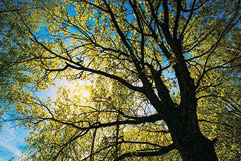
INSIDE A TREE TRUNK: There is so much about everyday things in our lives that we do not understand. When we see a tree, we have no idea what lives inside that tree's trunk. Recent studies by scientists have found that inside a tree trunk there are entire communities of bacteria. A single mature tree hosts about 1 trillion bacteria, with different communities living in various layers.
What is especially remarkable is that some of the bacteria living deep inside a tree trunk are anaerobic, meaning they do not need oxygen and produce methane. The outer layers of wood may absorb some of the methane, but more research is needed on that. The study's lead author said that the inside of a tree trunk is more like a wetland, where anaerobic bacteria and methane producers thrive in low-oxygen environments.
Genesis 1:12 tells us that God formed trees (the Hebrew word ets) as a special creation, separate from grasses or gymnosperms. That simple statement hides how complex it really is to make a tree trunk.
Reference: Scientific American, November 2025, page 20
BUMPY SNAILFISH DISCOVERY: Researchers at the Monterey Bay Aquarium Research Institute announced the discovery of a new deep-sea snailfish species called the bumpy snailfish (Careproctus colliculi). This fish lives over 10,000 feet below the ocean's surface and exhibits traits never seen before in the snailfish family.
Other deep-ocean snailfish are sleek and dark-colored, which helps them catch prey and blend into the dark waters. The bumpy snailfish is pink, with a large head and a body covered in bumps. These bumps are gelatinous, watery tissue that may help keep the fish buoyant under the high pressures of the deep sea.
Evolutionary explanations for how the bumpy snailfish came to be are unclear because its traits do not seem to increase its chances of survival but may instead make it more vulnerable to predators. Like all living things, it occupies a specific niche in the ecosystem. Dr. Mackenzie Gerringer, who analyzed the species in detail, said the discovery of this and two other species “is a reminder of how much we have yet to learn about life on Earth.”
Reference: foxweather.com and mbari.org
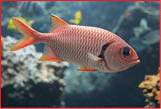
FISH COMMUNICATION: A fascinating question that marine scientists have studied is https://doesgodexist.today/fish-communication-methods/. Finding a mate, locating food, and defending territory are challenges all animals face. Land animals solve this by pushing air through their lungs, with different designs among land species. Birds and lions produce sounds for communication in different ways, but both rely on air in some form. So, the question is, how do fish communicate?
Researchers from Cornell University placed equipment in the ocean off Hawaii and Curacao to study this and found that each fish species has its own way of communicating. Triggerfish slap their pectoral fins on special scales. Glasseye snappers rattle their swim bladders. Blackbar soldierfish use sonic muscles to vibrate their ribs. Aaron Rice, who managed the project for Cornell, states that the “sounds lack the elegance of birdsong, but they are significantly more diverse.”
The more scientists learn about life on our planet, the more varieties of specialized designs they observe everywhere. Seeing these as outcomes of design is an example of intelligent purpose, allowing a vast diversity of life forms to exist.
References: Cornell Chronicle, sciencedirect.com, and fisheyecollaborative.org
HUMAN HIBERNATION RESEARCH: One of the most fascinating aspects of the natural world is how different animals survive the winter. Hibernation allows various animals to enter a state lasting weeks or even months, during which their body functions slow down, and they return to normal when warm weather arrives. Researchers in medical science are exploring ways to induce human hibernation. Besides enabling long space journeys, it could also be very useful for treating heart attacks and strokes.
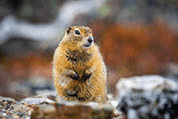
Among the animals being studied are Arctic ground squirrels and grizzly bears. Arctic ground squirrels have a body temperature of 99° F (37° C) from April to October. From October to April, their body temperature drops to 27° F (-3° C), and their heart rate can decrease to as low as one beat per minute. A hibernating brown bear does not experience such drastic temperature changes. The bear's temperature drops to around 90° and stays at that level from November to March, then rises back to summer levels. The bear undergoes a five-month period of torpor that conserves energy and maintains normal functions. For female bears, this includes giving birth and nursing cubs.
The effectiveness of these and other hibernation strategies is clear. Small animals like squirrels cannot store enough body fat to survive the winter, but bears can accumulate enough fat to sustain them for five months. Bears lose weight, so when they emerge from the den at the end of winter, they are very lean and very hungry.
Medical scientists are investigating how to induce human hibernation because it could extend the window for critical care of stroke and heart attack patients. The research focuses on how humans might benefit from changes in body temperature to fight various diseases. Like everything else, we aim to develop medical treatments by learning from what God has already created.
References: nationalgeographic.com and wikipedia
Answers to the 1st Quarter 2026 CROSSWORD puzzle: ACROSS: 3-prodigal; 7-lie; 8-love; 9-abiogenesis; 10-archaea: DOWN: 1-Jupiter; 2-cosmology; 4-Alaska; 5-nothing; 8-meaning
Picture credit:
Picture credit:
© zurijeta/Bigstock.com
© frank600/Bigstock.com
© Rich Carey/Bigstock.com
© Grisha Bruev/Bigstock.com
© cphoto/Bigstock.com
© PhotoSpirit/Bigstock.com
Scripture links/references are from BibleGateway.com. Unhighlighted scriptures can be looked up at their website.