
Return to 1st Quarter 2026 articles.
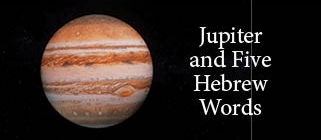
Jupiter is by far the largest planet in the solar system. Its mass is 2.5 times greater than the combined mass of all the other planets. It separates the inner solar system planets (Mercury, Venus, Earth, and Mars) from the outer planets (Saturn, Uranus, Neptune).
A study led by Andre Izidoro of Rice University in Houston showed that Jupiter shaped the structure of the solar system. As the solar system formed, Jupiter's massive gravity prevented gas and dust in the inner solar system from being pulled into the Sun. While gas and dust swirled around the newly formed Sun, Jupiter's gravity created ripples that formed rings of material, which clumped together through gravity to form the inner planets, including Earth. Later, as the planets took shape, Jupiter's gravity helped stabilize their orbits. According to Izidoro, “Jupiter didn't just become the biggest planet — it set the architecture for the whole inner solar system. Without it, we might not have Earth as we know it.”
Earth needs Jupiter because, without it, the material that formed the planet would have spiraled into the Sun. More than that, Earth still needs Jupiter today. The gravity from this gas giant acts as a shield, protecting our planet from comets coming from outside the solar system. Additionally, Jupiter influences Earth's climate cycle.
Genesis 1:1 tells us, “In the beginning, God created the heavens and the Earth,” but it does not specify the process God used or how long it took. If the Bible included every detail, it would be an enormous book. But the Bible is not a science book, and scientists are still exploring the processes God used in creation.
It is fascinating to consider how complex the creation process must have been, yet the first verse of the Bible contains the essential facts — there was a beginning, and God made it happen. The creation of a functioning universe, a solar system, and a planet destined for human habitation is summarized in five Hebrew words — “r eshith elohim bara shamayim erets” — which translate into the ten English words of the Bible's first verse.
— Roland Earnst
Picture credits:
© cobalt88/Bigstock.com
Scripture links/references are from BibleGateway.com. Unhighlighted scriptures can be looked up at their website.