
Return to 4th Quarter 2025 articles.

by Roland Earnst
Many animal rights advocates argue that we should treat animals the same as humans. To do otherwise is what they call “speciesism,” and they consider it perhaps even worse than racism. Why should humans be favored over other species? What makes humans so special?
An article in Scientific American caught my attention. It was written by Kate Wong and titled “Humans Are Not So Special After All.” The article points out that since 1960, when Jane Goodall observed a chimpanzee using grass and twigs as tools to coax termites from their nests, people have discovered that animals can do things previously thought only humans could do. Wong suggests that humans are not unique and that even plants can think and count.
Observations have shown that animals can perform amazing feats, but is it not possible that they do these things because they were programmed for survival by their Designer? It seems to me that the examples Wong provides fall short of proving her point. What makes humans so special involves more than the intelligent actions animals perform.
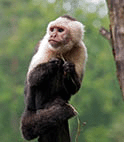
One example Wong uses is that brown capuchin monkeys decline a treat when they see another receiving a better one. She claims this shows a “sense of fairness,” but could it not also indicate a sense of greed? Would it not be a greater indicator of a sense of fairness if the monkey refused a better treat when he saw another one receive a lesser treat? How about if the monkey decided to share with another monkey that received less? Would that not better indicate a sense of fairness?
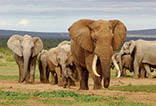
Wong also states that apes, monkeys, and elephants “mourn the loss of bonded individuals.” However, that makes sense because those species are programmed with a group/herd mentality that depends on each other for survival. She also mentions how mice and rats are affected by the pain or suffering of a fellow species member; but rather than compassion, could that not be fear for their own safety?
Wong also mentions an orca that made worldwide headlines for carrying her dead calf for 17 days while swimming 1,000 miles. To me, that appears to be a programmed survival instinct that failed to recognize there was no hope for the calf’s survival. The Eurasian magpie that “recognized itself” in a mirror reminds me of a turkey rooster that “recognized” his reflection in my basement window and kept tapping on the glass to challenge this supposed “competitor” for his territory.

For an example of plant “consciousness,” Wong presents the Venus flytrap and the fact that it “remembers” being touched. After two touches, it closes to trap the insect. After five touches, it secretes enzymes to digest the prey. But this does not demonstrate “thinking.” It is very simple to program a counting subroutine that causes a device to perform an action after two, five, or any number of signals from an outside source. That is programming, not thinking. The same applies to plants that produce chemicals summoning predators for defense when an animal chews on them. Again, it seems to be a survival program built into the plant.
Wong mentions anthropomorphism as “ascribing human thoughts, feelings, and motivations to animals.” While that is something people often do — particularly with dogs — I think Wong herself may be guilty of it.
The bottom line is that none of the cited examples can compare to what makes humans so special. Humans alone are created in the image of God. We have minds unlike the brain functions of any animal. When we see animals do amazing things, we should give credit to the Creator who gave them those survival abilities.
Picture credits:
© griny/Bigstock.com
© Anolis/Bigstock.com
© ZambeziShark/Bigstock.com
© MakroBetz/Bigstock.com
Scripture links/references are from BibleGateway.com. Unhighlighted scriptures can be looked up at their website.