
Return to 4th Quarter 2025 articles.

from Does God Exist? 4th Quarter 2025
STAY UP-TO-DATE ON NEWS AND NOTES. The stories in News and Notes are condensed from articles previously published on our website DOES GOD EXIST? TODAY. You can use the links within each of these articles to see the original posts (on the Does God Exist? Today website) for more details. (Some of the articles below have links to outside sources, which may not be available after we have published this page.) There are also many other interesting and informative articles on the Does God Exist? Today website each day. We encourage you to follow us daily on “Does God Exist? Today.” On that website you can also subscribe to our free weekly e-mail update. We call it “The Best of the Week from DOES GOD EXIST?” It contains links to the most popular of our posts on DOES GOD EXIST? TODAY and our facebook page (Facebook.com/evidence4god).
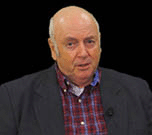
OPPORTUNITY TO STUDY WITH JOHN CLAYTON: Because of the COVID pandemic and age, we have suspended our lectureship schedule. In place of that, we are providing an opportunity for congregations to have a lectureship electronically. We want to give the readers of this publication the same opportunity to study with John Clayton.
We will mail you a DVD of the first four lectures in our video series. You or your group can watch the four programs writing down questions and challenges to the material. Please send us your questions via e-mail or postal mail, and John Clayton will respond to them. If you are satisfied with that material, return the DVD, and we mail you the next one. Your only cost is the return postage for the DVD.
If you are interested in this opportunity, please send us your name and address, and we will send you the first DVD. Watching the Does God Exist? presentations in the comfort of your home is an excellent way to receive the information without risk from COVID or the inconvenience of driving to a lectureship site. E-mail your request to John Clayton at jncdge@aol.com.
REFERENCES can be seen when one looks at the links within the articles below, references are at the bottom of those articles.
A SALAMANDER'S TOES: A recent report by researchers at Washington State University explains how the wandering salamander (Aneides vagrans) can climb, jump, and glide from limb to limb in the forests from California to British Columbia. These salamanders can control the blood flow to their toes to expand or contract the surface area. In this way, they can attach or detach from tree surfaces. They can release from one limb, glide to another, and instantly attach as they wander through the coastal redwood forests. God has endowed each living creature with the features necessary to adapt and survive in changing environments.
References: Discover magazine, July 2025, page 10, and the Journal of Morphology, January 2025

MARIJUANA USE BY OLDER ADULTS: Researchers at the University of Michigan found that in 2024, 21% of adults aged 50 and older used cannabis in some form. A study of emergency room visits in California from 2005 to 2019 found a 1,804% increase in cannabis-related ER visits among people aged 65 and over. In Canada, cannabis was legalized in 2020, and ER visits by older adults have skyrocketed since then. Marijuana use by older adults may suggest they are unaware of the significant increase in cannabis potency compared to their younger days. The fact is that using marijuana in any form is risky, and there is still much we do not understand about the long-term effects.
Reference: AARP Bulletin, July/August 2025, page 32
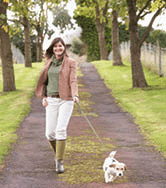
WALKING UPRIGHT: A Reuters News Agency article titled “How Humans Evolved to Walk Upright” fails to mention a critical design feature for walking upright. The article discusses a study of pelvis designs in primates. It suggests that the shape of the human pelvis explains how humans walk upright. However, upright posture involves more than just the pelvis.
The opening into the skull connecting the spinal cord to the brain is called the foramen magnum (Latin for “great hole”). It is positioned at the center of the human skull, but in other primates, it is located towards the rear. Besides the pelvis, the foramen magnum's position is an essential part of the design that supports bipedalism, or walking upright on two legs. The human pelvis also plays a crucial role in forming the birth canal that allows the passage of babies with larger brains.
Researchers identified over 300 genes involved in the design that enables walking upright. Many DNA regulatory elements must work together to accomplish what seems so simple to humans. Bipedalism enables us to use our hands for carrying objects, using tools, creating art, raising and cooking food, while we can observe our surroundings from a higher vantage point. Was this unique design merely an accident of natural selection, or the work of an intelligent Creator?
FRAUD IN SCIENTIFIC RESEARCH DATA: Some scientists are becoming very concerned about fraud in scientific research data. They face pressure to publish research papers to secure grants, advance their careers, or gain prestige. When financial gain is involved, scientists may be tempted to falsify the statistics they report. A recent study suggests that the number of fraudulent scientific publications is growing “at a rate far outpacing that of legitimate science.” Scientists rely on the work of others and depend on the accuracy of published research. When data is falsified for financial gain, it can be deadly, especially in medical research. Faking scientific data for personal gain damages scientific knowledge. Artificial Intelligence (AI) is becoming increasingly important across many fields, including medicine. If AI is trained on false data, it creates even bigger problems.
In all human endeavors, there are instances of fraud, and that includes scientific research. Science and faith in God are friends, but humans are not always trustworthy, and that applies to both science and religion.

GLOWING BIRDS-OF-PARADISE: The more than 40 species in the Paradisaeidae family, known as birds-of-paradise are more than just colorful; they are extravagant in their ornamentation and in their mating rituals.
Birds-of-paradise inhabit the rainforests of New Guinea and Australia, where they showcase their dazzling colors and remarkable features. Rene Martin of the University of Nebraska exposed some specimens of birds-of-paradise at the American Museum of Natural History to UV light. She discovered that 37 species showed biofluorescence under ultraviolet light. Seeing them with human eyes was impressive, but for a bird's specialized eyes, it must be even more dramatic. Unsurprisingly, the males glow the most. This discovery reminds us that it is easy to overlook what is right in front of us. What new insights will science uncover about God's creation in the coming days and years?
AI STUFFED ANIMALS: Small children love stuffed animals and often treat them as if they are real “friends.” What happens when you add AI to the toy? It can now respond to a child's questions and even their moods. Stuffed toys incorporating interactive AI, have positive potential. The toys can tell stories and answer the child's questions. Children can learn new words faster than by merely watching passive media. It can also reduce excess screen time and encourage them to be more active. However, if the AI toy becomes the primary companion for a young child, it could harm the child's social awareness and communication with real people. Interaction with other humans, whether children or adults, can teach a child empathy, conflict resolution, and the importance of sharing. The AI toy will always accommodate the child's wishes and moods, and will never say “no.”
Another important factor to consider with AI stuffed animals is privacy, since they are internet-connected to monitor a child's conversations. They could potentially store, analyze, and possibly misuse conversations of nearby adults. Some AI toys work locally without sending conversations to servers, which is worth considering. The bottom line is that limiting time with AI stuffed animals is just as important as limiting screen time for young children. But it may be harder to pry a child's attention away from a stuffed “friend” than from the television or game screen.
TREE MICROBIOMES: A study of microbiomes in living tree trunks reveals that the woody tissues of trees host a trillion microbial cells in addition to the cells of the tree. This includes single-celled bacteria and archaea. The study shows that microbiomes in living tree trunks vary from species to species. But how do these microbes get inside the trees? It might happen through wounds or openings, or they could be passed through the tree's seeds. Perhaps there is another route scientists have yet to discover. Regardless of the method, “What looks like one thing is a trillion-in-one organisms living together.” When you see a tree, you might not realize how intricate its design is. Genesis 1:11-12 states, “Then God said, ‘Let the land produce vegetation: seed-bearing plants and trees on the land that bear fruit with seed in it, according to their various kinds,’ and it was so. ”
THE CANA WEDDING FEAST: We read in John's gospel that Jesus performed his first miracle at a wedding in Cana of Galilee. Jesus turned six large stone jars of water into wine. But where exactly was Cana? We know it was in Galilee because John mentions it, but the exact location has long been disputed. An archaeologist believes he has found the site of Cana and the wedding feast.
Jesus was present at the wedding with his first disciples, who had been followers of John the Baptist just days before. Mary, the mother of Jesus, was also there, so this wedding was likely for a close friend or family member. The reason for Jesus performing this miracle might have been sympathy for the embarrassment of the wedding host, but it could also have been to help his new disciples develop faith (see John 2:1-11).
Natural processes can turn rainwater into grape juice over time, but Jesus had the power to accelerate this without a grapevine. There was no reason for him to ferment the grape juice to cause intoxication. When the master of the feast tasted it, he remarked, “You have kept the good wine until now.” That suggests the wine at this feast was not intoxicating.
Since the 18th century, the location of Cana and the wedding feast has generally been identified as Kafr Kanna, an Israeli town in Galilee. Now, archaeologist and historian Tom McCollough suggests that Cana was actually located five miles north of Kafr Kanna, at a site called Khirbet Qana. This was a Jewish village from 323 B.C. to A.D. 324. McCollough also notes that rabbinic texts and the writings of first-century Jewish historian Flavius Josephus support this site.
The significance of identifying the location of Jesus' first miracle is not for pilgrims to visit and venerate the site. Instead, it shows that the gospels describe real historical locations and events. Jesus is a real person, and Cana was a real place.
NATURAL ENVIRONMENT PAIN RELIEF: Experience has shown that spending time outdoors in a natural environment can help relieve stress and promote relaxation. A new study indicates that enjoying the beauty and peacefulness of God's creation can actually reduce the sensation of pain.

To create a controlled laboratory test, the researchers used images and sounds that depicted urban, indoor, and outdoor settings. For the test, the subjects were exposed to increasing-intensity shocks while the researchers monitored their brains with MRIs. The test subjects exposed to the urban and indoor environments showed the expected brain activity when sensing pain. However, the areas of the brain that receive pain stimulus were dulled when viewing the natural environment.
You could call it “natural” pain relief. According to Maximilian Steininger, who authored the study, they found that the pain relief was not just a placebo effect. It really worked. When feeling pain (or stress), getting outside to enjoy God's creation might be the best medicine. Enjoying God's creation also inspires us to worship and thank him for the beauty we enjoy in the outdoors.
Reference: Discover magazine, September/October 2025, page 20
Answers to the 3rd Quarter 2025 CROSSWORD puzzle: ACROSS: 4-irrelevant; 6-weakness; 10-forgiver: DOWN: 1-purpose; 2-fled; 3-Matthew; 5-merciful; 7-fair; 8-pure; 9-mind
Picture credit:
Picture credit:
© BAZA Production/Bigstock.com
© omgimages/Bigstock.com
© szefei/Bigstock.com
© Maridav/Bigstock.com
Scripture links/references are from BibleGateway.com. Unhighlighted scriptures can be looked up at their website.