
Return to 4th Quarter 2025 articles.

This ministry is dedicated to providing evidence. Our first topic is the existence of God. We see the creation of time, space, and matter/energy from a dimension beyond the three-dimensional world in which we live, as demonstrated in cosmology, quantum mechanics, and nuclear physics. If we can agree that there is a being we call “God” who created all we see in the physical world, that raises more questions. “Who or what is the nature of God, and how does he communicate with us?” The Christian answer is “through the Bible.” The question then becomes, “How do we know that the Bible is not just a collection of ancient fairy tales full of mistakes and myths?”
It is essential to emphasize that we are not talking about any English translation of the Bible. The King James translators made several mistakes, and that is true of newer translations such as the NIV. Reformers such as Martin Luther (Lutheran), John and Charles Wesley (Methodist), John Calvin (Presbyterian), and many other denominational leaders have also made errors in their understanding. When we ask whether the Bible is reliable, we are referring to the original writings in Hebrew and Greek, not what any human denomination teaches. Two lines of evidence support the reliability of the Bible.
SCIENTIFIC EVIDENCE
The first verse of Genesis in Hebrew is, “reshith Elohim bara shamayim erets.” Those words are translated, “In the beginning God created the heavens and the earth.” These words tell us two things:
- There was a beginning to time, space, and matter, as indicated by reshith.
- That beginning was caused by an intelligence in a dimension outside the physical realm, as indicated by the Hebrew word bara. This word is used only twice in the first chapter of Genesis. In verse 1, it refers to the creation of the physical cosmos, and in Genesis 1:27, it refers to the creation of the male and female soul — spiritual beings in the image of God. The rest of the Genesis account uses the Hebrew word asah, which refers to a natural process.


According to the biblical account, by the end of the first verse of Genesis, there was a functional Earth on which humans could exist. It is essential to note that Genesis 1:1 does not specify a date or duration. How long did God take to create the Earth suitable for humans? What method did God use to create the energy sources humans rely on? The Bible does not provide the length of time covered by Genesis 1:1 nor the method God used to produce oil and coal. Various denominations claim that the Hebrew word yom, translated as “day” in Genesis 1, can only mean a 24-hour day, but that is not true. In Deuteronomy 10:10, yom is translated as “time” and used for an event that is clearly not a 24-hour day.


The Bible states that plants were the first living things on Earth. The sequence of plant types given is grass (deshe), herb (eseb), and fruit tree (ets) producing fruit (peri) with seed (zera) in itself. Studies of Earth's fossil record confirm this sequence. Earth's earliest forms of life were stromatolites — fossilized algaeç consistent with the meaning of deshe. The second form of plant life in the fossil record is gymnosperms, fitting the biblical word eseb, meaning “naked seed.” Angiosperms are the most recent plant forms seen in the fossil record. The Hebrew word ets refers to a tree, wood, or stick — an angiosperm.
Similar agreement appears with the fossil evidence of animal life sequences. The order of animal life is important, not the timing. (For more on this, see God's Revelation in His Rocks and His Word on the doesgodexist.org website or available in a booklet from the Does God Exist? ministry).
HISTORICAL AND ARCHAEOLOGICAL EVIDENCE
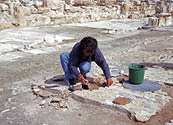
It is impossible to separate historical evidence from archaeological evidence because archaeology verifies the Bible's historical record. In the academic world, there are two main views on archaeological evidence: minimalists and maximalists. Minimalists are skeptics who dismiss religion and refuse to admit any support for the biblical record. Maximalists are believers who interpret every piece of evidence as supporting the biblical record.
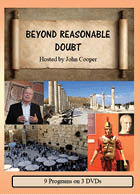
This ministry does not take sides in that debate. We offer a program of archaeological evidence, available through both our video series Beyond Reasonable Doubt and our 13-lesson correspondence course of the same name. They present archaeological evidence that the biblical record, while not complete, is accurate in everything it describes. Honest, reasonable people will see that the evidence showing strong archaeological support for the biblical record is compelling.
Do we have absolute proof that the Bible is free of errors? The answer is “no,” but you cannot absolutely prove that you exist either. Maybe you are just a hologram or a product of astral projection! But that is not how any of us live. The weight of the evidence is so substantial that we call our historical and archaeological material Beyond Reasonable Doubt.
Picture credits:
Cover: © Kotenko/Bigstock.com
© stevieg/Bigstock.com
© argus456/Bigstock.com
© timofeev/Bigstock.com
© MazurTravel/Bigstock.com
© inc/Bigstock.com
© ArenaPhotoUKl/Bigstock.com
Scripture links/references are from BibleGateway.com. Unhighlighted scriptures can be looked up at their website.