
Return to 3rd Quarter 2025 articles.
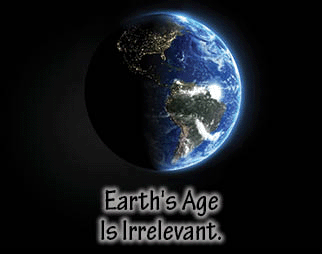
How old is planet Earth? Why does it matter? Various branches of science agree, based on strong evidence, that our planet is about 4.5 billion years old. Many Christians argue that it is only a few thousand years old, making it a matter of faith. In other words, if you disagree with their timeline, you are considered an evolutionist and a Bible denier. Scientists have methods for calculating Earth's age that do not involve faith or denying the Bible. The truth is that Earth's age is irrelevant to Christian faith.

Why do many Christians insist on a “young” Earth? It may be because they believe the Bible says so. They base this on a document written by James Ussher, an archbishop of the Church of Ireland, published in 1654. He calculated that Earth's creation took place on October 22, 4004 B.C., basing his calculations on the assumption that the genealogies in Genesis are complete and that they are recorded for the purpose of chronology. Those assumptions are incorrect. Biblical genealogies are incomplete and meant to show lineage, not precise timelines. Ultimately, the lineage led to the Messiah. Because early English translations of the Bible included Ussher's chronology, many came to believe it as gospel truth.

Another major reason many Christians today adopt the young-earth view is that they believe it refutes evolution. Scientists do not insist on billions of years because they want to allow time for evolution to occur. A little-known fact that scientists hesitate to admit is that 4.5 billion years is not long enough for unguided evolution to produce the diversity of life on Earth. In reality, no amount of time is sufficient for random mutations and natural selection to achieve this. Plus, a significant portion of that time would be needed just for the planet to cool and become capable of supporting life. Then, additional time would be necessary for non-living elements to organize into the first living cells. (They could not do it on their own, even in an unlimited amount of time, but that is another issue.)
Ultimately, Earth's age is irrelevant to Christian faith. While the age of Earth is crucial to geology, paleontology, astronomy, physics, chemistry, and other sciences, it does not impact the truth of the Bible or Christian beliefs. Archbishop Ussher was an intelligent church leader and scholar, but his chronology is flawed because it rests on false assumptions. False assumptions lead to false conclusions.
— Roland Earnst
Picture credits:
© CLIPAREA.com/Bigstock.com
https://commons.wikimedia.org/wiki/File:James_Ussher_portrait.jpg
© Tawng/Bigstock.com
Scripture links/references are from BibleGateway.com. Unhighlighted scriptures can be looked up at their website.